Meals Are Important

I made one of my absolute favorite recipes for supper this evening. Many of my friends know it as my Mexican Chicken recipe, because I make it often. In truth, it’s really my Mam-ma’s. It was one of my favorite meals when I was a child – and it still is one of my favorites today. Even though I know it by heart, almost every time I prepare it I drag out my copy of the Morrilton Assembly of God cookbook and turn to page 58, middle of the page. The recipe, just as Mam-ma wrote it years ago, is there for me to follow. I always smile when I get to the sixth ingredient listed – “½ of a 43 cent package of Taco Flavored Dorito”. In case you ever stumble onto this cookbook (which is not likely!) and want to prepare Mam-ma’s Mexican Chicken – let me translate that for you… The “43-cent” means the 9¾ ounce package – and it will cost you around $3.00 today.

I was only a toddler when this old cookbook was published and sold. To have one of my own, I had to run photocopies of my Mother’s cookbook – and I’m so glad I did. The recipes are treasures – and so are the names listed inside and faces they cause me to recall. Preparing this old casserole recipe brings so many precious people and wonderful memories to my mind. It connects me to people and places that I enjoy thinking about.

Cooking is like that for me. It connects me to others in a lot of different ways. Recipes that have been passed down, meals that have been enjoyed…..they all link back to people. When I make Mexican Chicken, I think of my Mam-ma. She was a driving force in my life, and I was so blessed to have her with me for my first 21 years on this earth. Mam-ma’s recipe originally required boiling and deboning a chicken – a task I’ve never really enjoyed. This past year, I purchased the Magnolia Table cookbook. Now, I follow the “Poached Chicken Breasts” recipe on page 85 – and I am grateful to Joanna Gaines and her team for the wonderful shortcut. What a great time-saver – and another connection. I also think of many great evenings when I served this dish to different guests and we spent time around the table laughing and talking.

Several weeks ago my pastor, Billy Burris, shared a brief devotional before our communion service that has really stuck with me. He talked about the significance and the intimacy of sharing a meal with others. When we eat together, bonds of friendship and/or family ties are strengthened. He talked about the importance of making meals special – of setting the table nicely, of preparing things well, of setting aside time to listen and connect. At mealtime, he said, we become vulnerable. We serve one another. We desire to share with others that which nurtures us. Bro. Burris’ message was a good one, and I have thought of it often since. Meal time is important!

Having a meal with someone is often a game changer. Acquaintances become friends. Friendships grow closer. Family ties are strengthened. Memories are made.

I remember seeing a T.V. interview with Dr. Maya Angelou many, many years ago. Oprah Winfrey was conducting the interview and she started enthusiastically talking about the fabulous meals she had eaten at Dr. Angelou’s table. Maya Angelou smiled and stated that preparing a meal for others is a very important task – because sharing a meal is a most intimate experience. She talked about the importance of every ingredient – and how she thinks carefully about her guests and what they would like. She talked about the opportunity you have to make others feel special by preparing a meal for them. I have remembered it until this day. Meals can be important events – with joy, strengthened bonds, and treasured memories as a result. People will remember the good experience!

Here’s an example. My Mother is almost famous for her tacos. (Its because they are incredible!) She has made thousands of them through the years – and people still (routinely!) ask her to prepare them. They are really, really good! In fact, several years after my Mam-ma passed away, her husband Harry (my mother’s stepfather) called to ask a favor. Would Mother be willing to drive down to North Little Rock and make tacos for him? He was getting older, he said, and he would just love to have her tacos one more time. He mentioned that he had tried to explain to his new wife how to prepare them, but they just weren’t the same.

That next weekend, I rode with Mother down to Harry’s. We carried in all the groceries and she settled in and went to work. When she got ready to fry the tacos, Harry (who usually always sat in the den watching T.V. until the food was ready) was this time sitting at the table waiting eagerly for the delicious meal he was anticipating. Mother heated the grease and dropped the first taco in to fry. The hot grease sputtered and began to sizzle loudly. I saw Harry’s face just light up. He looked at his wife beaming and said, “There! That’s it! That’s the way they always sounded!” It makes me smile now thinking about it. Those tacos brought Harry a lot of joy that day – and we all had such fun sitting at the table eating and sharing.

Meals are important.

If you would like to try Mam-ma’s Mexican Chicken, click here for the recipe:  Mam-ma’s Mexican Chicken

Thank you, Mrs. Turner – Teachers Make a Difference

I remember a time a few years ago when a good friend of mine, Bob Leftridge, asked me if I knew the answer to a trivia question – and thankfully I did. He chuckled when I told him the answer – and then said in his pleasant, musical drawl – “Well, that’s pretty good, but I’ll bet you can’t say your alphabet backwards!” I instantly lit up – because, in fact, I CAN say my alphabet backwards…..really….and I had been waiting many years for someone to ask!

I learned to say the alphabet first from my Mother. As a toddler, I had a little desk with all the letters of the alphabet painted around the edges. I would point at them one at a time while she would tell me the names…until I could finally identify and say them by myself. I thought it was great fun! When I turned five years old in April of 1972, kindergarten was not offered in Conway County, Arkansas public schools. I loved to learn, so Mother and Daddy enrolled me in Mrs. Reba Turner’s half-day kindergarten that fall.

I was so excited and nervous the first day of school, but Mrs. Turner quickly put us all at ease. I looked forward to going to school every day. In her kindergarten, we started every morning with a prayer – and then we said the alphabet together. Mrs. Turner had the alphabet strip neatly tacked on the wall above the chalkboard. She would lead us by walking along and touching one letter at a time with a pointer. When she got to Z, she would slowly move back up the list until we returned to the letter A. Therefore, to this day I know my alphabet forwards and backwards.

Mrs. Turner’s kindergarten was held in her home. I suspect our little school was originally a carport – but it now served beautifully as our classroom. She had a lovely space for us to learn – and a fun playground out back. She was strict but kind, always well-prepared, and conscientiously dedicated to our success. I can remember one day when one of my classmates showed us how much fun it could be to break crayons using only one hand. We watched his demonstration carefully, then excitedly dug into Mrs. Turner’s big bucket of crayons and began practicing our new skill. When Mrs. Turner saw what we were doing, she had a talk with our little group about the importance of respecting others’ property, and how we should take care of things rather than ruin them. I still remember that lesson to this day. (I truly think we broke every crayon in the bucket.)

Of all my days at Mrs. Turner’s kindergarten, one in particular has always stood out in my mind. Mother dropped me off as usual that morning and I went into our little classroom. The lights were off, and there was no one to be seen. I went up and knocked on the door that led into Mrs. Turner’s home. She came to the door, and I could tell she was a little surprised to see me. She quickly apologized for not being in our classroom to greet me and started turning on lights. She explained that every single one of my classmates would be absent that day because it was “Orientation Day” for upcoming first graders at Morrilton Elementary. Because I lived out in the country, I would attend a different school that fall and was not involved in the special day. In other words, Mrs. Turner obviously thought she had a day off – until I showed up. As it turned out – it was a wonderful morning…because I had Mrs. Turner all to myself. I sat in her lap while she read to me. We colored a picture together. We sang songs, and I got to help her straighten up our classroom. I loved every single minute! When Mother came to pick me up at lunchtime and found out that I had been the only one there all morning, she was embarrassed and apologetic. Mrs. Turner quickly and calmly assured her that it was fine – there was no reason to apologize. Years later, I would have to agree – because it provided me with a pleasant memory I cherish to this day.

Mrs. Turner’s little private kindergarten was a wonderful way to begin my many years of schooling. She started me off well on my educational path, and I am forever grateful. I can honestly and wholeheartedly say I owe her a lot.

Before she began her home kindergarten, Mrs. Turner taught all grades (1-8) together in little one-room schools. In fact, she taught my mother and my aunt in a small community known as Lords Schoolhouse. Even though Mrs. Turner grew up only about 10 miles or so from that little neighborhood, she boarded with my grandparents while she taught school there. In rural Arkansas in those days, it was the school parents’ responsibility to house the teacher. Room and board were part of the compensation teachers received. Reba Turner moved in with my grandparents and stayed until the end of the school term. Just little girls, my Mother and Aunt Helen would walk with her to school each day. They lived almost a mile from the school, so when the weather was cold or rainy the walk was a challenge. My Pap-pa bought an older used car for Mrs. Turner to drive to school. Even though it was not a great car, and from what I have heard it was often hard to start – it was still appreciated. One morning, my grandparents left home early, leaving Mrs. Turner at home with their two little girls. When it came time to leave for school, the stubborn old car once again wouldn’t start. Mrs. Turner had an idea. She and her two little students pushed the car to the edge of the drive just before it sloped sharply down to the highway. She pumped the gas pedal a few times to get it primed, then Mother and Aunt Helen worked together to give it a push and started it rolling down the incline to the road. Using that momentum, Mrs. Turner got the car started and carefully braked so that her two waiting students could catch up, get in the car, and head to school. They worked together to solve the problem – and it makes me smile to picture it in my mind.

Through the years, I have often thought about what Mrs. Turner (and others) modeled for me regarding education. When I started out as an educator, I patterned my teaching after those I had learned from myself. From their examples, I firmly believe one of the most important things a teacher can do for their students (of any age) is work to build relationships from day one. Getting to know students and letting them know you care is a critical element to their academic success. Students, just like everyone else, need to connect with someone. When they view their teacher(s) as their partner(s) in learning, their attitudes, their self-esteem, and their chances for success improve drastically. I tried to always remember that during my years spent teaching in the classroom, because it’s a great practice. I know. I learned it in kindergarten.

Mrs. Reba Turner passed away this month at the age of 86. According to her obituary, her remarkable teaching career spanned 58 years. During that time she taught approximately 2200 students.

Thank you, Mrs. Turner. You made a difference in our lives. We, your students, are forever grateful.

Hodgenville, Kentucky – Birthplace of President Lincoln

The history of people and places has been a passion of mine since I was a little girl in elementary school. I can remember going to the library as a third grader at Berryville Elementary and always heading straight to the shelf that held the biographies. In fact, I can still picture in my mind where that shelf was located. I couldn’t wait to get a new book each week. I read about amazing people like Amelia Earhart, Orville and Wilbur Wright, Babe Didrikson Zaharias, Daniel Boone, Davy Crockett, Clara Barton……and Abraham Lincoln. I’ve continued that love of biographies and history through the years. I think I get some of that interest from my parents. Daddy enjoyed visiting historic sites and learning the significance of people and places. Mother is a reader – and she enjoys learning of the contributions and relevance of others. Whatever the reasons, I really enjoy digging into history to explore and learn new things. I believe there is so much value in learning where we came from, knowing the challenges and accomplishments of those who went before us, and recognizing the impact of others on our world today.

One week ago today, while heading from Nashville to just outside Cincinnati, I turned off the highway to detour through Hodgenville, Kentucky. Only a few miles off I-65, Hodgenville has a population of just over 3,000 people. Each year, this little town in rural Kentucky gets around 250,000 visitors from all over the world…because it is the birthplace of a man of great and long-lasting impact on the world, President Abraham Lincoln. If you’re ever in that area, I highly recommend taking a detour to spend a couple of hours seeing all the little town has to offer. The address of the birthplace is 2995 Lincoln Farm Road – but don’t bother writing it down. If you can find Hodgenville, you can find the birthplace!

President Lincoln was born just outside Hodgenville in February of 1809 – twenty-seven years before the town was officially incorporated. “Sinking Springs Farm”, the President’s birthplace, is a United States National Historic Park. Even on a chilly Sunday in March, several people were there visiting the site. We couldn’t all speak the same language verbally, but we were affably united in our admiration of the 16th President of the United States as we moved around the grounds. I remember a story Clay Cooper, a Branson, MO entertainer, told on his show. He and his wife Tina visited the Lincoln Memorial in Washington several years ago, and Mr. Cooper talked about how he noticed all of the different languages being spoken by the people around him as they walked up to view the monument. It really emphasized for him the far-reaching influence of President Lincoln that so many people from so many backgrounds and countries chose to visit the Memorial and pay honor. It was the same for me last week in Kentucky.

The cabin where President Lincoln was born is long gone. A replica cabin was built in same spot where the original cabin sat. A large stone memorial building has been built around that cabin. It’s really impressive and beautiful to see on the hillside above the spring. President Theodore Roosevelt traveled to Kentucky to officially lay the cornerstone for this building on the 100th anniversary of President Lincoln’s birth in 1909. Two years later, in 1911, President Taft visited Hodgenville to give the dedication speech at the completed memorial. (The Lincoln Memorial in Washington D.C. didn’t open until 1922 making this the “First National Lincoln Memorial”.) Since then, President Franklin Roosevelt and President Eisenhower have also visited the site.

We started at the visitor center. There are beautiful displays showing information about Lincoln’s life, his family, inspirational quotes from the President, and examples of life during the early 1800’s.

A walnut table built by President Lincoln’s father, Thomas Lincoln, is on display. It was beautifully made!

The Lincoln family Bible was also in the visitor center. I thought that was a treasure!

Despite being cold, it was a beautiful day. There is a nice board sidewalk from the visitor center to the memorial. It was a pleasant walk through the woods. It’s going to be really beautiful there in a few weeks when everything buds out. They keep the grounds very well-tended!

The Memorial building and the Replica Cabin sit on top of a hill above the old Sinking Spring. I worked to get pictures without others in them – so it looks as if it was not busy that day. Actually, there were several people there milling about the grounds. Everyone was quiet, polite, and friendly. It was a very pleasant atmosphere.

After the birthplace, it is a less than a 10-minute drive to the Knob Hill farm where the Lincoln family lived from the time Abraham was 2½ until he was almost 8. In 1860, President Lincoln wrote, “My earliest recollection is of the Knob Hill place.”

During the summer, the National Park Service has crops and farm demonstrations available. This time of year, it’s just a pretty spot to see. Informational markers are located around the grounds to read and imagine what life must have been like. President Lincoln’s baby brother, Thomas, was born at the Knob Hill Farm. He died shortly after birth and was buried with a simple marker made by his father to denote the grave. That marker is now on display at the Birthplace Visitor Center and a new marker has been donated at the gravesite.

According to the informational markers, Abraham Lincoln once almost drowned in Knob Creek. He and his boyhood friend, Austin Gollaher, were crossing the creek on a log footbridge when Abraham slipped and fell. Neither boy could swim, and the water was deep. Thinking fast, Austin Gollaher quickly pushed a long stick out for Abraham to grab so that Austin could pull him to safety.

Driving back into Hodgenville, it was too late to go to the Lincoln museum. It closes early! There are two impressive statues of President Lincoln that sit in the center of the city square. The first shows the President as a little boy. I loved it that he is posed reading books!

The pose of the second statue reminded me of the Lincoln Memorial in Washington. Even though it is located on a city square with traffic, this may have been one of my favorite parts of the visit to Hodgenville. This statue was dedicated in 1909 and has stately sat on the Hodgenville square for 110 years. President Lincoln’s son, Robert, attended the dedication ceremony to honor his father.

Lincoln’s Gettysburg Address and his Second Inaugural Address are engraved on the city square. It was nice to stop and remember the courage and significance of this man, to reflect on his simple beginnings and his powerful impact on the world then and now. According to the information at the Birthplace Visitor Center, President Lincoln had less than three years of formal schooling in his lifetime. Even so, he served as a lawyer, a legislator, and one of the most remembered and respected Presidents of the United States. Most importantly, President Lincoln emancipated the slaves and preserved the Union during the U.S. Civil War. Only 56 years old at the time of his assassination, President Lincoln’s life is inspirational to many and his impact long-lasting and far-reaching.

I really enjoyed my afternoon in Hodgenville. It was a beautiful and relaxing place to spend some time. More than that, it was nice to stop and think about the great contributions of President Lincoln that are still affecting us today. There was an article online that I read after visiting the Knob Hill Farm. It was talking about the afternoon that Abraham Lincoln nearly drowned as a young boy – and speculating how things could be different today had President Lincoln never lived until adulthood. It made me wonder what potential lies in all of us to have a lasting effect on the world around us in a positive way.

More information:

Abraham Lincoln Birthplace National Historic Park: https://www.nps.gov/abli/index.htm


Abraham Lincoln biography at History.com: https://www.history.com/topics/us-presidents/abraham-lincoln


Gettysburg Address: http://rmc.library.cornell.edu/gettysburg/good_cause/transcript.htm


Second Inaugural Address: https://www.ourdocuments.gov/doc.php?flash=false&doc=38&page=transcript


Emancipation Proclamation: https://www.archives.gov/exhibits/featured-documents/emancipation-proclamation/transcript.html


Interesting article about Lincoln’s near drowning – https://www.newspapers.com/clip/3549859/abraham_lincoln_saved_from_drowning_by/

My Pap-pa

Clifford Quinton “Joe” Clark
My Pap-Pa

When I was a little girl, it seemed like my Pap-pa was almost always working. From the stories I’ve heard all my life, it started when he was just a little boy…

His father, Ike, became sick, and eventually died young. I’ve never been certain what my great-grandfather’s illness was – but I do know that he suffered tremendously for many years. Pap-pa had to drop out of school to work the farm, care for his father, and support the family. He was young – but he was the oldest son. His sister Floy was four years older, but his brothers Woodrow and Dude were younger….so Pap-pa shouldered the responsibility. He grew up early.

He was only able to finish a third grade education at a little one-room school in rural Arkansas – but he had learned how to read and write, and thankfully he had a good mind for arithmetic. Those skills served him very well throughout his life.

I’m sure working the farm was hard enough, but Pap-pa had to carry even more responsibility. I heard stories as a child about how he alone was the one who cared for his father. From stories my grandmother would tell, it was gruesome work. Whatever the malady, Ike had dressings that had to be painfully changed and infections that had to be tended. His son, my Pap-pa, took care of it all. He was responsible for the family. I just can’t imagine.

He married my grandmother when he was only 17 and she was 14. They moved into a little house (more of a shed) behind his parents’ home. His father, almost completely disabled, required constant care – and Pap-pa continued to provide it. Working hard every day to support seven people would be grueling. Even more difficult, I think, was being responsible for so much at such a young age. In my entire life, I never once heard him complain about any of it. In fact, I don’t remember ever hearing him even talk about it. I heard the stories from others.

He got his first calf from a neighbor. He fed it, cared for it, and raised it to sell. That young calf became the first of many. Pap-pa found that he enjoyed tending cattle. He was good at it. For the rest of his life, Pap-pa earned a good living buying, tending, and trading cattle. He built and ran sale barns, he owned packing houses (a southerner’s term for a meat processing plant), and he raised cattle. When I spent time with him as a little girl, it was out in the pastures tagging along when he fed the cows, or hanging out at the sale barn he owned. He was happy to take me and my cousin Amy along when he tended his cattle. We would ride in the back of the truck (usually up on the sideboards) while he drove through the pastures to feed. It was fun – especially when he was out in the bottom land near the river. When he would drive over the levees, we would laugh and giggle – and hang on for dear life! Sometimes, Mother and I would ride with him to a sale. I loved the excitement of that! I would listen and try to understand what the auctioneer was saying……and sometimes Pap-pa might let me bid. It was big fun!

Those are good memories – but the best memories I have of Pap-pa are meals I have eaten at his table. You see, my Pap-pa also loved to cook. He mostly cooked at breakfast time – frying sausage, ham, and bacon. It was wonderful! He was very particular about the meat that he bought. He liked to get sausage from Atkins, Arkansas, because the recipe they used there to mix it is so very good. The ham had to be Petit Jean – because it is simply just the best there is. He bought slab bacon and hand sliced it himself with a sharp butcher knife. Since I grew up watching this, I never thought anything about it……until one day when I was in my 30’s I decided to try it. I bought a slab of bacon and nearly cut my fingers off trying to slice it. I finally admitted defeat – it was just too hard. Who knew???

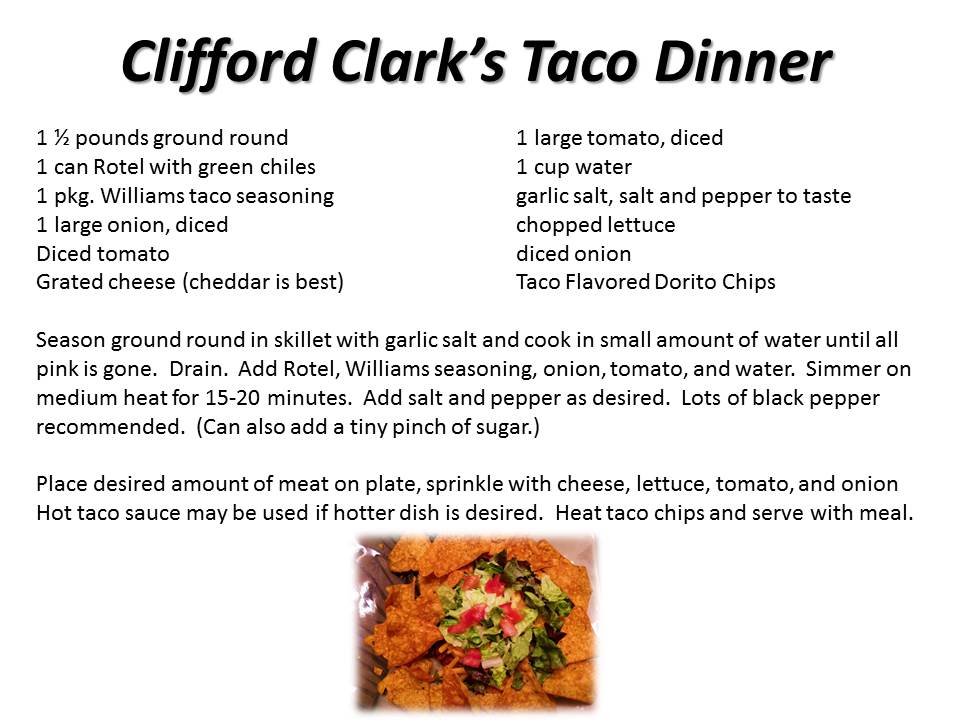
The only recipe of Pap-pa’s I have today in my recipe box is his “Taco Dinner”. It’s really good! A couple of years ago, I made this recipe for guests at my home. My cousin Betty recognized it – and it thrilled me. She remembered an evening when she and her husband Billy ate supper at Pap-pa’s house many years ago – and he served his Taco Dinner. I love adding that memory to the files in my brain.

Pap-pa would have turned 101 last month. He left us in 1999.

Fairly often, I pull out his recipe and have his simple but delicious Taco Dinner for supper. Every time I prepare it, I think of Pap-pa……and I smile. In case you’re interested, I thought I would share the recipe with you. It’s a good one. I really hope you enjoy.