The Cotter Bridge

Have you ever been to Cotter, Arkansas?

If you don’t live somewhere near Northwest Arkansas or Southwest Missouri, the answer might be no…and that’s too bad….because it is definitely a little place worth exploring!

When I was a little girl, my Daddy worked for a company called Ozark Sash and Door owned and operated in Springdale and Berryville, Arkansas by the Hanby family. Before the days of the big box stores, there was a hardware store of some type in most every little community. Daddy traveled a regular route weekly through Missouri and Arkansas, selling building materials to those little stores. Sometimes, Mother and I would ride with him…

On Tuesdays, his route took him from Harrison to Mountain Home, with many stops in between. Traveling the old 62 highway back in those days took us across the Cotter Bridge…

The old bridge is unique in many ways. Sitting high above the White River, it is beautiful with its patented rainbow arches and lighted lamps. As a little girl however, crossing the bridge was fun for another reason. When on the bridge headed toward Cotter, a large, old railroad trestle sits to your left, angling diagonally toward your path. It intersects the Cotter Bridge just at the end, crossing underneath at the last minute. Sometimes, a train would be chugging across that trestle bridge just as we, in Daddy’s truck, were driving across the Cotter bridge. It was always exciting – looking just a tiny bit like we were surely about to collide with the train (in my little girl’s mind). It was a little bit scary – and lots of fun!

The Cotter Bridge has an interesting history. According to the Encyclopedia of Arkansas, it was completed in 1930. Originally operated as a toll bridge to recoup construction costs, it allowed east-west travelers a reliable White River crossing. Ferries used previously were often unavailable due to frequent flooding in the area, and the closest detour crossing was 100 miles to the north in Branson, Missouri. Designed by the Marsh Engineering Company in Des Moines, Iowa, the graceful structure is still beautiful today.

When highway 62 was rerouted near the turn of this century, a new bridge was built just a short distance to the northeast. Thankfully, the old bridge was preserved and remains open to vehicle traffic for anyone who likes to veer off the beaten path.

All these years later, a visit to the Cotter bridge is still something I enjoy. I make the drive over several times a year…it’s a great little day trip. Beneath the bridge, there is a pleasant little city park on the banks of the White River. Big Springs Park is a relaxing gathering place for families, fishermen, and old folks…

The park pays homage to Cotter’s railroad history with a caboose, a statue, and some interesting informational markers to read as you wander about. There’s also a boat ramp, fishing spots, picnic tables, benches, a covered pavilion, a sand volleyball court, a quaint little gazebo that could serve as a bandstand, a walking path, and best of all a true old-fashioned swimming hole complete with a rope swing.

It’s fun to visit the park on a summer afternoon or evening, to sit and watch the kids play in the swimming hole, to picnic, or just set up your lawn chairs in a shady spot, enjoy the cool breezes blowing in from the river, and visit with folks from all over. Cotter, after all, is known as the “Trout Fishing Capital of the World” and many people travel miles to enjoy this quaint little town. I always drive to nearby Gassville first, to pick up a pizza at Nima’s. (This little pizza place has won numerous awards including “Best in the U.S.” at national competitions and even “Best in the World” at international events. Definitely a “don’t miss” place!)

The best part of the park, however, are the magnificent views of the historic old bridge. I hope you enjoy the images I captured last month on one of my day trips over there. It truly is a beautiful, peaceful, and rejuvenating spot.

Click here for a shortcut to the gallery. Thank you for stopping by!

Forrest L. Wood

I’ve heard about fellow Arkansan Forrest L. Wood for most of my life, but sadly I never had the privilege of meeting him in person. My daddy visited with him once or twice and considered it an honor. I certainly knew of Mr. Wood’s notoriety. I have seen his plaque on the Arkansas Walk of Fame in Hot Springs. I’ve heard the stories of his many noteworthy accomplishments in the fishing industry. In the early 1980’s, my high school GCE teacher, Mr. Jerry James, took my class on a field trip to tour Ranger Boats, the company Mr. Wood founded and operated for many years. Last summer, while on vacation approximately 665 miles from home, I had lunch at a restaurant on the shores of Lake Pepin in the tiny village of Pepin, Wisconsin. While chatting casually with a couple who had boated in that day to eat at the little restaurant, I spotted the man’s Ranger Boats ball cap. When he found out I was from Arkansas, he asked if I knew Forrest Wood.  It was fun to feel that connection to home from all those miles away, to smile with pride at the mention of one of Arkansas’ own.

Forrest L. Wood, a native of Flippin, Arkansas, achieved worldwide fame as the Father of the Modern Bass Boat. Most anyone in the fishing industry readily recognizes his name. According to the Encyclopedia of Arkansas, Mr. Wood began building boats in 1968 in the back of a filling station. That was the beginning of Ranger Boats, a successful business he owned and operated with his wife, Nina until 1987. More recently, Mr. Wood played a vital role in the development of an exciting new boat company, Vexus Boats, again in his hometown of Flippin.

In the late 1990’s, Mr. Wood was appointed to the Arkansas Game and Fish Commission by (then) Governor Mike Huckabee. A legend in the sports fishing industry, Mr. Wood received numerous accolades and honors in his lifetime including (to name only a few) – induction into the Arkansas Business Hall of Fame and the Arkansas Sports Hall of Fame, the Lifetime Achievement Award from the Sportfishing Association of America, the Lifetime Achievement Award from the BASS Federation, and the Arkansas Outdoor Hall of Fame Legacy Award. The FLW Tournament was named in his honor. The list truly goes on and on and on…

The state of Arkansas lost an iconic legend last Saturday when he passed away at the age of 87. The news spread quickly on social media. Posts began popping up on Facebook, Twitter, and Internet news, as many friends, family members, and fans paused their busy days to stop and pay tribute to a gentleman they admired greatly. Reading through those tributes and personal stories shared this week, the true success of this legendary giant is realized.  My eyes have teared up more than once.  Here is just one example: (Please read it – it’s definitely worth your time.)

Success comes in many different forms. For some, it means material wealth, widespread fame, the achievement of goals and dreams, and a legacy that continues long after you are gone from this earth. Mr. Wood achieved all of these in his lifetime – but reading through the many tributes shared this week – it is readily apparent that he achieved much, much more. I was taught that the true success of a person is told by their character. By all evidence, Mr. Wood’s character, faith, integrity, and work ethic are his most impressive and enduring legacies. His life, a life well-lived, should be a role model for many.

He truly was a success.

The Old Mill

This past week, I had an appointment in Little Rock, Arkansas. As soon it was over, I headed to The Old Mill in North Little Rock to walk around, relax, and take a few pictures before starting the drive home. I first visited the Mill in the early 1980’s, when my step-grandpa drove our family over to see the beautiful spot. I was instantly enchanted! I had been by the turn to the Old Mill countless times, but I had never noticed the sign directing me to this peaceful hidden valley tucked quietly away just a mile and a half from McCain Mall’s busy shopping area. In fact, this lovely, tranquil spot is located only five miles from the bustling Arkansas State Capitol complex. How unique is that?

I love finding beautiful or historic or interesting spots to explore. Wherever you are, there are so many things to see and do – and many of them cost nothing but your time! To me, summertime – the time of year when the days are longer and sometimes a little more relaxed – is a perfect time for road trips!

When I was a child, Sunday afternoons typically meant Sunday drives. After church and then lunch (we called it dinner in the American South), we would settle into the car and spend the afternoon driving around to “see the countryside”. I love the memory of those pleasant drives – learning new roads, seeing new things, and revisiting favorite spots. It is a practice I continue, in some ways, to this day. Who knows what hidden gems can be discovered in just a 50-mile radius of our homes or travel destinations! Every place has a story. Whenever I travel anywhere – even for business or appointments, I try to find something to do to make the trip FUN. It’s something I learned from my Mother years ago. When I was a kid, I didn’t like being cooped up in the car on a long drive – so Mother and Daddy would play the billboard alphabet game with me…or Auto Bingo…or find a good spot where we could stop and go wading together – whatever they could do to make the day enjoyable. Now, whenever I travel – I am thinking about somewhere I can stop or something I can see that will bring joy to my day.

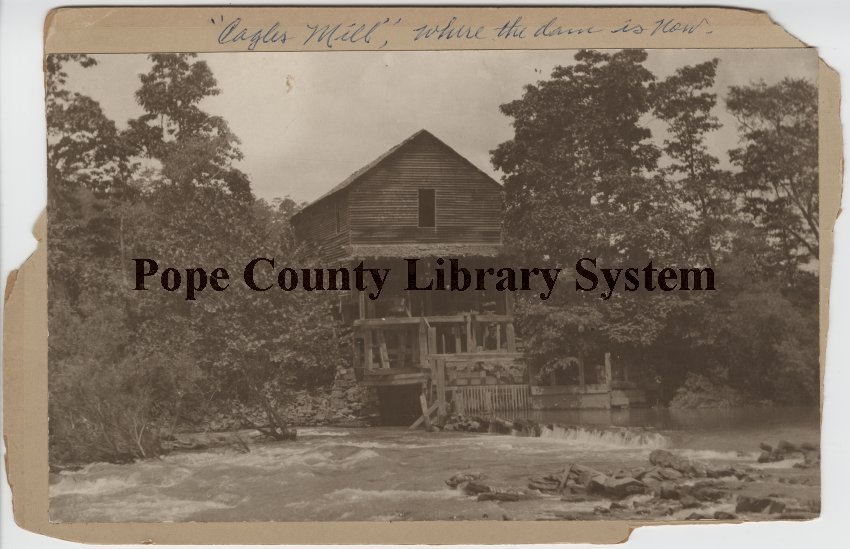
If you’ve been to the North Little Rock area and never seen The Old Mill, I encourage you to check it out on your next trip. It’s worth your time to stop by. Built in 1933, the Old Mill building was never intended to be a working grist mill. It was instead built as a tribute to remember the days of old – when grist mills were a gathering point for communities, providing services needed for settlers’ survival. Inside the rock building is an authentic iron grist mill moved to North Little Rock from the long-gone Cagle’s Mill in Pope County, Arkansas. (Cagle’s Mill operated in the 1800’s between Russellville, Arkansas and Dardenelle, Arkansas – located about where the Dardanelle Lock and Dam is now. If you’re interested – click here to see a picture of the Old Mill from the Pope County Library. A long-time Russellville restaurant is named in its honor.)

The park surrounding the mill, Pugh’s Memorial Park, is beautifully landscaped and maintained. Walking trails go down by the lake and climb the slope behind the Mill. Beautiful bridges, benches, and footpaths, sculpted from a sturdy concrete-like substance to look as if they are made from wood, are found all over the park. They are remarkably detailed and very well preserved – despite the fact that they are over 80 years old. According to the information sign displayed near the park entrance, developer Justin Matthews commissioned Dionicio Rodriguez, to create the remarkable works of art. His sculptures have survived to this day, and they are spectacular to see. No one knows the formula Senor Rodriguez developed to create the material for his works, though many have tried to figure it out. He preferred to keep it secret and hid the process from everyone – making it unfortunately now lost forever.

The Old Mill brought long-lasting notoriety to the state of Arkansas only a few years after it was completed. Director David O. Selznick featured the location in the opening credits of the 1939 Academy award-winning movie Gone With the Wind. No one knows why the location was chosen, but the Old Mill building is believed to be the only surviving structure of the movie. The Arkansas location was the site of the national unveiling of a postage stamp commemorating the fiftieth anniversary of Gone With the Wind.

It was a humid, blisteringly hot afternoon when I drove over to Lakeshore Drive this week – but when I walked into the park I forgot all about the heat. It is such a beautiful, peaceful spot. I was instantly, once again, enchanted. If you’re passing through the Little Rock metropolitan area and have an extra half-hour or so, please consider driving to The OId Mill at 3800 Lakeshore Drive in North Little Rock. I really think you’ll be glad you did! Wear your walking shoes, take your camera, or a book to read, or an iced tea to sip – and spend a few minutes enjoying the lovely serenity of the park.

I hope you enjoy the pictures! I definitely had fun taking them to share with you!

My Pap-pa

Clifford Quinton “Joe” Clark
My Pap-Pa

When I was a little girl, it seemed like my Pap-pa was almost always working. From the stories I’ve heard all my life, it started when he was just a little boy…

His father, Ike, became sick, and eventually died young. I’ve never been certain what my great-grandfather’s illness was – but I do know that he suffered tremendously for many years. Pap-pa had to drop out of school to work the farm, care for his father, and support the family. He was young – but he was the oldest son. His sister Floy was four years older, but his brothers Woodrow and Dude were younger….so Pap-pa shouldered the responsibility. He grew up early.

He was only able to finish a third grade education at a little one-room school in rural Arkansas – but he had learned how to read and write, and thankfully he had a good mind for arithmetic. Those skills served him very well throughout his life.

I’m sure working the farm was hard enough, but Pap-pa had to carry even more responsibility. I heard stories as a child about how he alone was the one who cared for his father. From stories my grandmother would tell, it was gruesome work. Whatever the malady, Ike had dressings that had to be painfully changed and infections that had to be tended. His son, my Pap-pa, took care of it all. He was responsible for the family. I just can’t imagine.

He married my grandmother when he was only 17 and she was 14. They moved into a little house (more of a shed) behind his parents’ home. His father, almost completely disabled, required constant care – and Pap-pa continued to provide it. Working hard every day to support seven people would be grueling. Even more difficult, I think, was being responsible for so much at such a young age. In my entire life, I never once heard him complain about any of it. In fact, I don’t remember ever hearing him even talk about it. I heard the stories from others.

He got his first calf from a neighbor. He fed it, cared for it, and raised it to sell. That young calf became the first of many. Pap-pa found that he enjoyed tending cattle. He was good at it. For the rest of his life, Pap-pa earned a good living buying, tending, and trading cattle. He built and ran sale barns, he owned packing houses (a southerner’s term for a meat processing plant), and he raised cattle. When I spent time with him as a little girl, it was out in the pastures tagging along when he fed the cows, or hanging out at the sale barn he owned. He was happy to take me and my cousin Amy along when he tended his cattle. We would ride in the back of the truck (usually up on the sideboards) while he drove through the pastures to feed. It was fun – especially when he was out in the bottom land near the river. When he would drive over the levees, we would laugh and giggle – and hang on for dear life! Sometimes, Mother and I would ride with him to a sale. I loved the excitement of that! I would listen and try to understand what the auctioneer was saying……and sometimes Pap-pa might let me bid. It was big fun!

Those are good memories – but the best memories I have of Pap-pa are meals I have eaten at his table. You see, my Pap-pa also loved to cook. He mostly cooked at breakfast time – frying sausage, ham, and bacon. It was wonderful! He was very particular about the meat that he bought. He liked to get sausage from Atkins, Arkansas, because the recipe they used there to mix it is so very good. The ham had to be Petit Jean – because it is simply just the best there is. He bought slab bacon and hand sliced it himself with a sharp butcher knife. Since I grew up watching this, I never thought anything about it……until one day when I was in my 30’s I decided to try it. I bought a slab of bacon and nearly cut my fingers off trying to slice it. I finally admitted defeat – it was just too hard. Who knew???

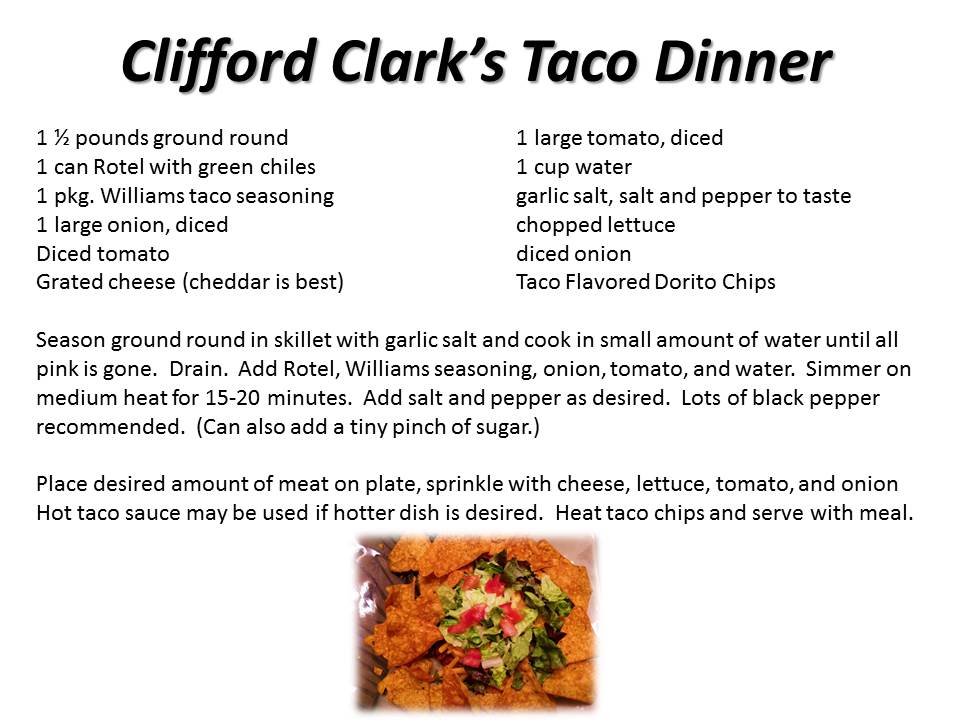
The only recipe of Pap-pa’s I have today in my recipe box is his “Taco Dinner”. It’s really good! A couple of years ago, I made this recipe for guests at my home. My cousin Betty recognized it – and it thrilled me. She remembered an evening when she and her husband Billy ate supper at Pap-pa’s house many years ago – and he served his Taco Dinner. I love adding that memory to the files in my brain.

Pap-pa would have turned 101 last month. He left us in 1999.

Fairly often, I pull out his recipe and have his simple but delicious Taco Dinner for supper. Every time I prepare it, I think of Pap-pa……and I smile. In case you’re interested, I thought I would share the recipe with you. It’s a good one. I really hope you enjoy.